Tools & Devices
The instruments that go out to sea, the electronics that keep them running, and the software that turns the data into results.
Tools & Devices brings together what the project builds to do its own work: the instruments that go out to sea, the electronics that keep them running, and the software that turns what they bring back into usable data.
PlatePrep
PlatePrep turns field photographs of settlement plates into images ready for annotation. It's a single HTML file that runs in the browser — no installation, no server, and the photographs never leave the computer. It was developed for Bioē's coatings experiment and is generic enough for any campaign of flat, roughly square plates.
In five guided steps, the tool gathers the campaign's metadata — much of it read directly from the photos' EXIF and GPS data, with an optional weather lookup — groups the photographs by plate and rectifies each one by four-corner homography, at a fixed physical scale. The output folder receives the named crops, a metadata table ready to import into CoralNet, the triage map, a manifest recording the four source corners of each crop, the physical scale embedded in each JPEG, and a calibration macro for ImageJ.
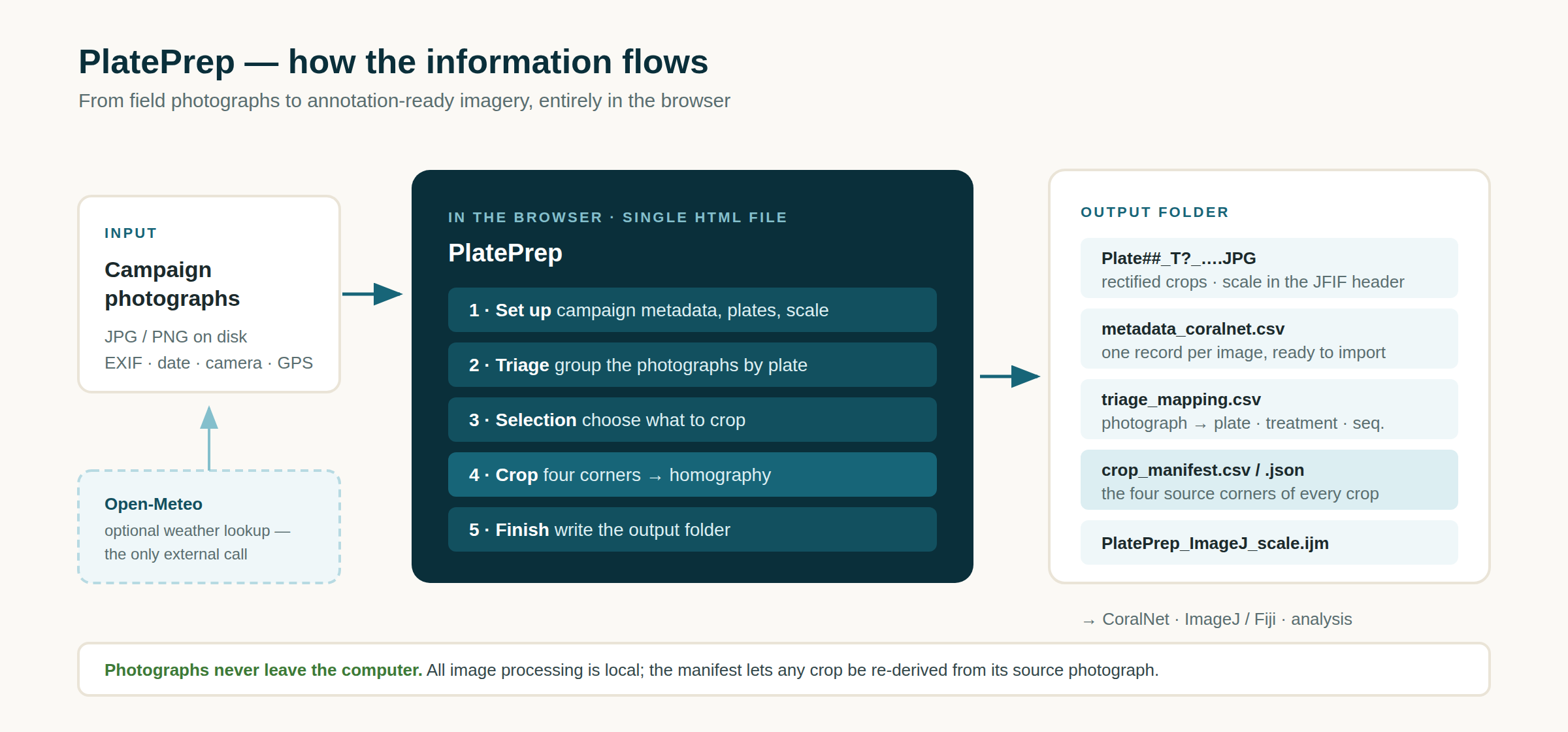
From field photograph to annotation-ready image, entirely in the browser.
Monitoring and Signaling Buoys
Bioē builds autonomous platforms that measure, record and transmit sea data on their own — designed for remote locations, where maintenance is expensive and infrequent.
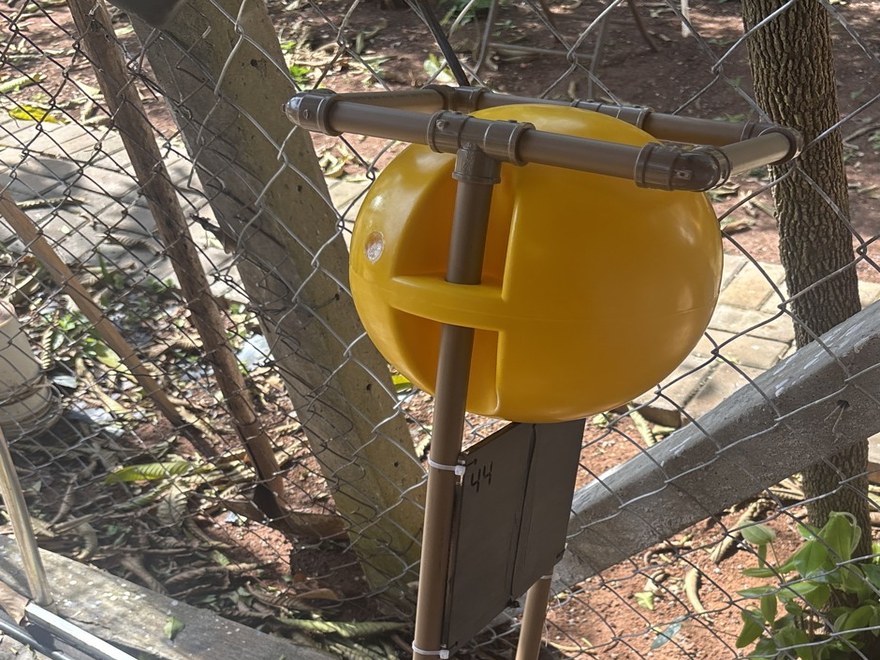
The ESP32-based TS buoys record temperature and the potential of an electrode pair over Wi‑Fi; the current generation uses a long-range LoRa network, with land-based base stations and a Bluetooth console for field checks. The T1 buoy is dedicated to continuously measuring the open-circuit potential of the test plates, and a large steel-hulled oceanographic buoy is being refurbished to operate in the São Sebastião Channel, alongside CEBIMar–USP.
Firmware, scripts and hardware documentation are version-controlled in the project's GitLab, with a public mirror on GitHub.
DC–DC Converters
Low-power boost converters, developed to raise and stabilize the electrical output of the bioelectrochemical systems, so that this energy can be used by autonomous devices such as the signaling buoys.
Want to know the full project?
Full scope, history, team and detailed experiments are on the official Bioē site.
See the full Tools & Devices